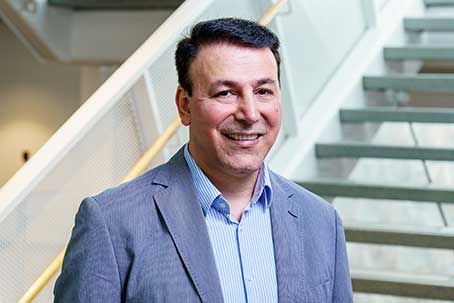
Dr. Daniel Hashemi is an Assistant Professor of Physics in the Department of Physics, Optical Engineering, and NanoEngineering at Rose-Hulman Institute of Technology. He uses quantum-mechanical calculations and computer simulations to understand how atomic structure shapes the electronic, magnetic, and optical properties of materials. His research spans two-dimensional materials, defect-based quantum sensors, magnetic nanostructures, and materials for energy applications. Before joining Rose-Hulman, he held research positions at the University of Michigan, the Air Force Research Laboratory, and Toyota Research Institute of North America. He works closely with undergraduate researchers on projects connecting fundamental physics with materials and device design. His teaching emphasizes physical intuition, computational problem-solving, and opportunities for students to investigate open research questions.
Academic Degrees
- Ph.D. in Physics, Martin Luther University Halle-Wittenberg / International Max Planck Research School, Germany, 2015
Teaching Interests
- Introductory physics, including mechanics, electricity and magnetism, and laboratory instruction.
- Computational physics and nanoengineering, including numerical modeling and scientific programming.
- Semiconductor materials, electronic structure, and device applications.
- Nanoscale materials, thin films, and their fabrication and properties.
- Quantum sensing and research-based learning in computational materials science.
Research Interests
- Quantum sensing with atomic defects: predicting the spin properties and responses to electric fields and strain of defects in hexagonal boron nitride and other wide-band-gap materials.
- Two-dimensional materials and heterostructures: understanding and controlling electronic phases, interfacial charge transfer, and responses to strain.
- Magnetism and spintronics: investigating magnetic nanostructures, magnetic anisotropy, and orbital and valley responses in layered materials.
- Energy materials: studying defect chemistry, proton and ion transport, and materials for batteries and solid-state conductors.
- Organic electronic materials and molecular interfaces: connecting molecular structure and interfacial interactions to electronic and optical properties.
- First-principles modeling: combining electronic-structure calculations, atomistic simulations, and high-performance computing to predict materials behavior.
Publication & Presentation Highlights
- DongYeon Kim and Daniel Hashemi. “Spin–Strain Coupling and Direct Stark Response of the VᵦCᵦ⁰ Center in Monolayer hBN.” 2D Materials (2026). https://doi.org/10.1088/2053-1583/aea342
- Braden Smith and Daniel Hashemi. “Spin–strain coupling of a neutral carbon-dimer triplet in monolayer hBN.” Physical Chemistry Chemical Physics (2026). https://doi.org/10.1039/D6CP02922A
- Nico Simoni and Daniel Hashemi. “Substrate control of the electronic phase of low-buckled plumbene.” RSC Advances (2026). https://doi.org/10.1039/D6RA06623B
- Coauthor, “2D van der Waals Inorganic Oxychloride Proton Conductor.” ACS Applied Energy Materials (2022). https://doi.org/10.1021/acsaem.2c00289
- Daniel Hashemi and collaborators. “Substrate-Controlled Magnetism: Fe Nanowires on Vicinal Cu Surfaces.” Nanomaterials (2020). https://doi.org/10.3390/nano10010159
- Invited research talks at the U.S. Naval Research Laboratory (2016) and IBM Research–Almaden (2010), along with contributed presentations at American Physical Society meetings and international nanoscience conferences.
Awards & Honors
- KEEN Entrepreneurial Mindset in Undergraduate Research Award, Kern Family Foundation / Rose-Hulman Institute of Technology, 2026
- Principal Investigator, DOE Oak Ridge Leadership Computing Facility allocation: 18,000 node-hours on Frontier, 2026.
- Principal Investigator, Argonne Leadership Computing Facility Director’s Discretionary allocation: 4,000 node-hours on Polaris, 2026–2027.
- Principal Investigator, NSF ACCESS computing allocation: 400,000 service units on Purdue Anvil, 2026–2027.
- National Research Council Research Fellowship, Air Force Research Laboratory, 2017–2019.