How Rose-Hulman Is Reimagining Higher Education’s Value Proposition in STEM
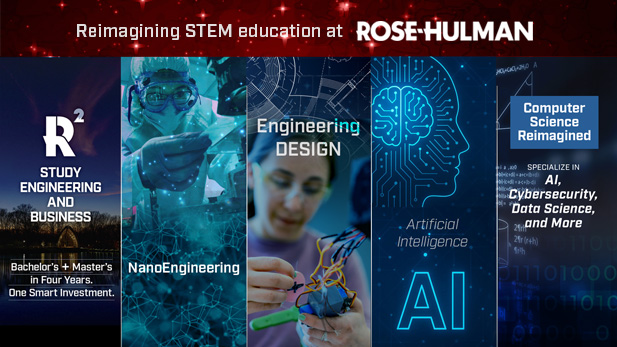
Rose-Hulman is redefining STEM education with three new majors—Engineering Design, NanoEngineering, and Artificial Intelligence—along with an expanded Rose Squared (R²) program and a redesigned computer science curriculum aligned with emerging fields.
As questions about the relevance and return on investment of higher education continue to intensify, Rose-Hulman has adopted a straightforward stance: demonstrate value through academic innovation, rapid execution, and a focus on return on educational investment. Just since 2020, the STEM mission-focused college—long known for hands-on learning and close faculty mentorship—has accelerated the launch of new programs, revamped existing majors, and invested in next-generation experiential learning spaces shaped by bold institutional vision and direct industry insight.
These moves are not incremental. They reflect a strategic effort to adapt to rapidly shifting workforce needs and to prepare students for the realities of an AI-driven, globally competitive economy, not a theoretical one. These efforts are informed by close collaboration with industry partners, including advisory boards made up of industry leaders who regularly provide insight into workforce needs. Faculty integrate this input into coursework, mentored research, and capstone projects to ensure graduates are prepared for high-impact roles in industry or advanced study. One of the clearest signals came with the launch of three new majors—Engineering Design, NanoEngineering, and Artificial Intelligence—programs that would be ambitious even for large research universities.
Excellence in teaching is a top priority, and as Rose-Hulman Provost Ellen Goldey noted, “Our faculty members employ research-informed pedagogical practices, and they freely share ideas and support each other while also holding themselves—and each other—accountable to a very high level of teaching effectiveness. And our students are the beneficiaries of these high standards.”
NanoEngineering, in particular, places undergraduates inside a cleanroom environment and device-characterization labs typically seen only in graduate-level settings. Students work with nanofabrication tools, model quantum-scale devices, and collaborate with faculty on research in photonics, semiconductors, and next-generation energy materials. Access to this level of nanofabrication and characterization technology is typically reserved for graduate-level programs, making early undergraduate exposure a distinctive feature of Rose-Hulman’s approach.
Just as forward-looking is the Engineering Design major, developed for students who want to move ideas from concept to reality and solve problems with human-centered, interdisciplinary thinking. The program integrates mechanical, electrical, software, and systems design with rapid prototyping, sustainability principles, and iterative engineering practice — preparing graduates to work in emerging spaces where boundaries between engineering disciplines are dissolving. Students don’t just learn to design solutions; they learn to design the right solutions.
This emphasis on emerging fields also drove a major redesign of the computer science curriculum. Rose-Hulman now offers a unified Computer Science major with two distinct pathways—Developer and Researcher—paired with new specializations in artificial intelligence, cybersecurity, and data science. The goal: give students a flexible, future-ready academic structure that can evolve as computing evolves.
Complementing these additions is Rose-Hulman’s new major in artificial intelligence, reflecting both the urgency and complexity of the field’s rapid growth. Designed to balance technical depth with responsible application, the program immerses students in both modern and classical AI while emphasizing the ethical frameworks needed to guide its use.
“Higher education cannot afford to move at the pace it once did,” said Rose-Hulman President Robert A. Coons. “When industry and student needs transform in real time, our academic structures have to be flexible enough—and bold enough—to transform with them.”
That shift is already resonating with the industry. Eric Graves, senior advisor data scientist for Eli Lilly’s Advanced Intelligence Group, said the rapid expansion of AI is pushing employers to look beyond traditional talent pipelines. Graves was recruiting at Rose-Hulman’s fall career fair in October as a first-time attendee.
“It’s very rapid, it’s very evolving, and we want to see what the talent pool is here because there is so much work to be done in AI development,” Graves said. “We’re looking for the newest and bleeding-edge tech researchers, and that’s coming out of these types of universities.”
Rose-Hulman has also leaned into accelerating students’ academic trajectories. Its growing Rose Squared (R2) program allows students coming out of high school with qualifying credits to earn both a bachelor’s and master’s degree in four years at no additional cost. Launched in 2020, the program has quickly grown. A record 13 percent of last year’s graduating class completed a master’s through R2—with a master’s in Engineering Management being the most common option—a number the institution expects to climb as demand rises for specialized, graduate-level preparation.
Employers say these experiences show up quickly on the job. “A lot of it is the collaborative, project-based work,” said Kyle Pinches, director of talent acquisition and onboarding at SEP. “That’s not something every school does. Here, it happens often, and it mirrors how we work as teams.”
The outcomes extend beyond the curriculum. Through its Advancing by Design strategic plan, launched in 2023, Rose-Hulman has committed to embedding sustainability, global leadership, innovation, and affordability into its educational model. Innovation Grove—a new entrepreneurial district slated to open in 2027—will anchor much of this work. The $102 million Innovation Grove project, supported in part by a historic $30.5 million Lilly Endowment grant, will bring together Rose-Hulman Ventures, Union Health, the Indiana Orthopedic Institute, and new academic and community-facing facilities. The recently launched Noblitt Entrepreneurship Program will further strengthen these efforts, giving students structured pathways to develop, test, and advance new ideas alongside industry partners. The vision is to place industry and academia side-by-side, giving students hands-on access to real problems, real partners, and real venture-building opportunities long before graduation.
For employers like Carvana, the direction is clear. “It’s the speed of contribution and the depth of experience from the coursework,” said Shawn Humphries, director of engineering at Carvana Wholesale. “Rose graduates become integral team members more quickly than many other schools.”
Perhaps the strongest endorsement comes from the consistency of outcomes: Rose-Hulman has been ranked No. 1 in undergraduate engineering education by U.S. News & World Report for 27 consecutive years. Campus leaders emphasize that the ranking is not the goal, but rather the byproduct of continual reinvention and a sustained commitment to excellence.
At a moment when the value of higher education is being reevaluated nationwide, Rose-Hulman is betting that agility, industry connectivity, and hands-on innovation offer a compelling answer. If recent employer demand—and record interest from students—is any indication, Rose-Hulman isn’t waiting for higher education to change. It’s building what comes next.