2026 Rose Show Ignites Innovation
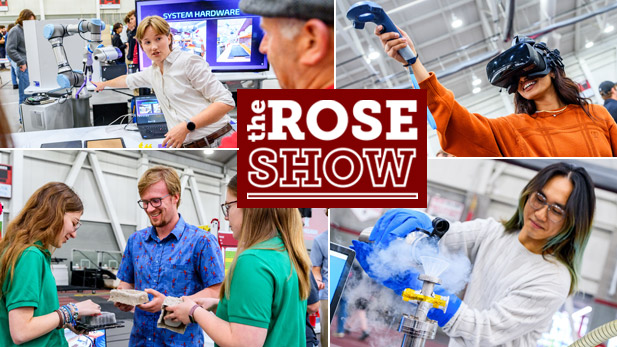
Students presented their capstone, design, studio, and research projects at the 2026 Rose Show, culminating their Rose-Hulman education with impactful, innovative projects.
Innovation unfurled throughout Rose-Hulman, cascading a sense of immense awe over visitors to the 2026 Rose Show on May 6. Nearly 130 student teams showcased their design, capstone, research, and studio projects, the culmination of countless hours of testing and ideation.
The teams excavated their creativity from their coursework, producing futuristic innovations that, at times, felt like something out of a sci-fi novel, with robotic arms stretching across aisles and 3D printers producing prints seemingly in thin air.
"From improving quality of life for individuals, to supporting local and regional partners, to advancing ideas with global implications, each project reflects a shared purpose: to make a meaningful impact on the world," said President Robert A. Coons as he kicked off the event.
Dubbed the "collegiate World's Fair", the Rose Show represents the pinnacle of a Rose-Hulman education, and around the room, entrepreneurship bloomed. Throughout the year, several teams built products to launch their own startups, performing customer analysis to take their products to a commercial market.
Alex Stedman, Philip Pounds, and Alex Yim of Unlayered 3D developed a novel approach to 3D printing, using a multi-axis nozzle to print projects without supports. Meanwhile, Adam Jirovec, Davis Rubel, Owen Clowney, and Aaron Nadharajan designed and built a carbon-fiber, electric motorcycle as a more lightweight, nimble alternative to existing motorcycles.
Every project represented months, if not years, of careful research and design, with hundreds of hours invested in calculations, code, or CAD files. As their projects progressed, teams resolved manufacturing bottlenecks experienced both by themselves and by their clients.
Frustrated by the amount of time required to produce and ship custom printed circuit boards (PCBs), DJ Bernard, Prabhat Vadlamani, Django Wardlow, and Colin Young designed a benchtop manufacturing process to fabricate 4-layer PCBs in a matter of hours.
PCBs power modern technology, including other Rose Show solutions such as a robotic arm for Two Six Technologies. The arm and its custom manufacturing jig accomplish key tasks, including PCB positioning, in a collaborative style designed to allow humans to work safely in tandem with technology.
PCBs also powered the excavator payload estimation system, a loading aid to help excavator operators fill haul trucks to a target weight using inclinometers, hydraulic pressure transducers, and a calibrated predictive model.
For some teams, the impact of their project extends far beyond the Rose Show, pioneering new intellectual property. Ryan Beerheide, Jared Doeden, Andrew Frush, and Ethan Newman worked with Milwaukee Tool, which is filing a patent for their design.
"I had the privilege of coaching an ambitious capstone design team from my alma mater, and they exceeded my expectations by delivering an innovative solution for the outdoor power equipment user," said Sean Casey, senior design engineer at Milwaukee Tool and 2019 biomedical engineering and mechanical engineering graduate. "Faced with an open-ended challenge, the team showed extreme ownership in defining, analyzing, prototyping, and ultimately testing a final product. What stood out most was their ability to communicate with clarity and confidence while leveraging each other's unique technical strengths to drive toward an original design from concept to completion."
Other projects' impacts are felt through the inspiration of prospective innovators. They created education stations, including a junior astronaut training center for Terre Haute's Gibson Allen Memorial Planetarium and an interactive vermicomposting system for the Montessori Academy of Terre Haute, as well as training simulations for healthcare professionals at Union Health.
Much like the actual World's Fair or other attractions, Rose Show visitors could even take home their own souvenir to commemorate the occasion: a pressed penny displaying one of five designs created by Katie Fightmaster, Jacob Ulewicz, Andrew Fong, and Nicholas Fong. Their mechanical engineering capstone project was a whimsical machine that will permanently welcome visitors to the Fowler Academic Building.
Some projects were less tangible, though no less tremendous. Civil engineering teams developed plans for infrastructure both local and global, including a revitalization proposal for Terre Haute's riverfront district and a layout for the Magnus Engineering headquarters in Mishawaka, Indiana. Computer science students wrote fresh lines of code that enabled virtual reality environments, as well as a build tool and support library to develop modifications for the Nintendo Switch.
Each and every Rose Show project highlights the possibilities of a Rose-Hulman education and emphasizes the impact of Rose-Hulman students and graduates on their communities. From cutting-edge startups to more accessible or sustainable solutions, the successes of each student team underscore the innovation at the heart of Rose-Hulman.
Award-Winning Projects:
William A. Kline Innovation Award Winner
Honoring Former Dean of Innovation Dr. Bill Kline
Unlayered 3D: Mass-Market Multi-Axis 3D Printing
Multidisciplinary Design
Alex Stedman, Philip Pounds, Alex Yim
Desktop 3D printing has remained unchanged for the past 15 years in stacking layers vertically, leading to support waste material, bad surface finishes, and poor part strength.
But what if there was a way to solve this problem and print Unlayered. The patent-pending multi-axis 3d printing stack, from software to machine, gives engineers full control over their parts right off the build plate. All of this is just a few clicks away at a price point that an engineer can afford without paid software.
William A. Kline Innovation Award Finalists
Common Mode Filtering Applied to Data Transmission Structures
Electrical & Computer Engineering
Cami Lovelace, Rebecca Testa, Jacob Fields, Yejia Hao
Differential signaling is a method commonly used to transmit data at high speeds and with high signal integrity. Unfortunately, this method is highly susceptible to common mode noise, which can degrade the signal quality and increase data errors in large systems. This project aims to develop filtering structures for PCIe 5.0 (Gen 5) devices operating at 16GHz, attenuating common mode noise while allowing the desired differential mode signal to pass.
Excavator Payload Estimation System: Developed for Renascent, Inc.
Multidisciplinary Design
Michael Wilson, Jacob Cockerill, Toby Zhao, Connor Luce, Prithvi Vijaykrishnan
The Excavator Payload Estimation System is a loading aid designed to help excavator operators fill haul trucks to a target weight without relying on guesswork. It uses inclinometers, hydraulic pressure transducers, and a calibrated predictive model to
estimate bucket payloads. By giving operators real-time feedback through an in-cab user interface, the system improves loading consistency while reducing haul trips and overweight liability.
New Product Development – Milwaukee Tool
Mechanical Engineering
Ryan Beerheide, Jared Doeden, Andrew Frush, Ethan Newman
Due to the innovative nature of this project, details cannot be shared publicly.
Red Ribbon Department Awards
Flexible Easel
Biology & Biomedical Engineering
Elizabeth Johnson, Marina Cadilli
This client is a professional painter with fibromyalgia, a chronic pain condition that leads to heightened musculoskeletal pain and muscle fatigue. Amanda experiences many symptoms and is often exhausted after painting for extended periods. Amanda’s range of motion is affected by the paint in her shoulder, so she cannot raise her arm above her shoulder for extended periods. This device is intended to reduce her pain by providing an easel design that can ensure comfortable positions during extended painting sessions.
Music Biofeedback Device
Biology & Biomedical Engineering
Allison Kirk, Narindwa Semakula, Columba Rodriguez Real
Traumatic brain injuries (TBIs) often impair posture and motor control, reducing independence. This project developed a wearable music-based biofeedback device to promote upright head posture during rehabilitation for a TBI patient. A head-mounted tilt sensor connected to an Arduino UNO REV4 Wi-Fi monitors head position and adjusts music volume on an Apple device: increasing volume for goal posture and decreasing it when insufficient. This non-intrusive system leverages motivational feedback to encourage rehabilitation, supporting autonomy and consistent posture correction at home.
PneumaNode
Biology & Biomedical Engineering
Tommaso Calviello, Alyssa McGauley, Connor O’Connell, Katie Choi
The PneumaNode, developed by Team TACK in collaboration with ResperCare LLC, is a skin-adhering biosensing patch engineered for continuous monitoring in the NICU. The device integrates a MEMS microphone, PPG sensor, and an ESP32-S3 microcontroller on a custom PCB to acquire multiple vitals including heart rate, SpO2, temperature, and respiratory sounds. Embedded C++ firmware enables Bluetooth Low Energy transmission for real-time analysis. A TPU housing and multilayer adhesive provide structural integrity. The PneumaNode will reduce clinician workload and improve diagnostic consistency.
Temporary Pacemaker Training Device
Biology & Biomedical Engineering
Jonathon Croker, Cade Zonin, Austin Daly
This device is a versatile medical training simulation system designed to provide realistic, hands-on procedural practice for healthcare professionals while remaining affordable and easily accessible to institutions. This system is intended to simulate key aspects of surgical and clinical procedures, allowing users to develop technical skills and build confidence before performing procedures in real clinical settings. Unlike many existing commercial simulators, this training system prioritizes cost efficiency and ease of use without sacrificing educational value. The device is designed to be quickly assembled and deployed, making it suitable for simulation centers, classrooms, and resource-limited environments. Its durable construction allows it to withstand frequent use, while its intuitive interface ensures that both learners and instructors can focus on skill development rather than complex setup or operation. By providing a safe environment for repeated practice this system helps reduce the risk of errors associated with insufficient preparation, ultimately supporting improved patient outcomes and healthcare safety.
Boulder Buster Offroad Mobility Solution
Biology & Biomedical Engineering
Ezekiel Groom, Kevin Tang, Gregory Hippely
This project addresses the mobility needs of a 6’5” veteran with paraplegia, adhesive arachnoiditis, who sought to return to off-road driving and outdoor exploration. The team modified a TrailMaster XRS 200E by integrating a custom hand-control system that transfers all throttle and braking functions to the upper body, eliminating the need for leg input. Additional modifications include a repositioned seat mount for improved ergonomics, vibration-reducing components, and a reinforced transfer platform for independent entry and exit. The completed solution restores the client’s ability to safely and independently participate in off-road recreational activities.
Magnus Engineering Headquarters
Civil & Environmental Engineering
Benjamin Coons, Jadyn Winkler, Cobi Harris, Meropi Gkiouzelopoulou
Magnus Engineering is a structural engineering firm located in Mishawaka, Indiana. The company specializes in the analysis and design of structural systems for a wide range of projects, emphasizing technical excellence, efficiency, and innovation. As Magnus Engineering continues to grow and expand its practice, the firm plans to relocate to a newly constructed office building that reflects both its professional identity and forward-looking vision. The new facility is intended to embody the character of the company while supporting collaboration and future expansion. At present, Magnus Engineering has purchased a site with existing development plans in place for the future headquarters. While there are buildings located in the surrounding area outside the property boundaries, the site itself is supported by existing infrastructure, including a parking lot, utility and electrical lines, and a septic system. These existing conditions provide a functional starting point for development while requiring careful evaluation to ensure compatibility with the proposed expansion and long-term operational needs. The proposed Magnus Engineering Headquarters will serve as the future home of the firm and consist of a modern, functional, and creative 8,000-square-foot office building featuring a basement, a partial second floor, and a covered outdoor patio. The architectural and structural design will reflect the company's identity through the use of exposed glue-laminated timber, composite Fiber Reinforced Polymer (FRP), and structural steel elements, accentuated by an extended entryway canopy. The interior layout will include a dedicated executive wing, a production wing for design staff, and shared spaces such as conference rooms, collaboration areas, a kitchenette, and restrooms. Site improvements will involve evaluation of the existing stormwater management system and assessment of parking lot capacity to accommodate potential future expansion. The project will be completed under the supervision and expertise of Magnus Engineering's professional staff.
Rose Data
Computer Science & Software Engineering
Weston Seybold, Caleb Lehman, Jay Smith, Colin Flannagan
Rose Data is an integrated platform for the Rose-Hulman Institute of Technology community, focused on student scheduling and degree planning. Students can view courses, create multi-term paths, explore AI-assisted degree plans, and coordinate schedules with peers. Advisors see student progress, degree plans, and enrollments to guide decisions. By linking schedules to degree requirements, Rose Data helps users stay on track and avoid conflicts. It serves as a lighter, more intuitive complement to Degree Works.
RESOLVE Verifying Compiler
Computer Science & Software Engineering
Nicco Scanu, Chris Lardner, Carson Holscher, Brian Pascente
The RESOLVE Verifying Compiler is a compiler designed not only to compile code but to mathematically prove that it works as intended. Being able to prove code works by design allows us to ensure that no valid input to a program can lead to unexpected output. This type of compiler would be applicable for use with critical system projects such as banking systems or navigation systems for spacecraft, where the margin of error has to be close to zero, as any error could have severe consequences. The goal of this project is to make progress on the prover component and enhance the efficiency of it.
FSAE EV BMS Firmware Development
Electrical & Computer Engineering
Braden Blanford, Henry Jung, Eric Soo-Yoshimura, Yicheng Zhu
Formula SAE (FSAE) is a prestigious engineering competition where university students design, manufacture and race small scale Formula-style open wheel racecars. The competition is split into 3/8 ‘static’ (cost judging, design judging, business case judging) and 5/8 ‘dynamic’ (acceleration, skidpad, autocross, endurance and fuel economy) events. Thus, scoring points is a nuanced and multifaceted challenge. RoseGPE is Rose-Hulman Institute of Technology’s FSAE team; with a history of over 14 years successfully competing at the main yearly North American event in Michigan, the team is currently amidst their transition from an Internal Combustion (IC) powertrain to an entirely electric one, and our senior design team has been commissioned to develop the firmware for their custom Battery Management System (BMS).
Ultra-wideband Range Asset Tracking System (uRATS)
Electrical & Computer Engineering
Peter Borger, Catherine Hodge, Lauren Marquardt, Conner Tavares
The Ultra-Wideband Range Asset Tracking System (uRATS), sponsored by NSWC Crane, provides quasi-real-time tracking of mobile assets in areas where electromagnetic interference is high. Ultra-Wideband (UWB) technology uses low-power, high-frequency, and a wide bandwidth to measure range between nodes through almost any potential interference. The uRATS system includes a server to collect range data and perform geolocation algorithms to track mobile objects and a display to show location of the mobile object on a world map that is updated approximately every second.
Solving Social Deduction Games: Lessons Learned and Ongoing Research
Mathematics
Daniel Leverett
In the field of game theory, games of interest sometimes involve asymmetric player information. In this paper, we analyze Secret Hitler, a boardgame in the genre of social deduction games characterized by such asymmetric information. In a social deduction game, or hidden role game, each player is assigned a role placing them on one of two teams, but not every player is aware of others’ role assignments. We develop a Bayesian inference model for an outside observer trying to determine players’ roles. Computational experiments for a restricted set of available player and team strategies demonstrate that an outside observer can often learn most players’ roles before the end of the game.
Confidence Distributions and Bootstrapping P-Values
Mathematics
Jacob Gerber
The two predominant schools of thought within the field of statistics are those of the Frequentists and the Bayesians. However, the formalization of the term “confidence” provides an approach to inference that lies somewhere in-between. Confidence distributions lie at the forefront of this approach. These “frequentist distribution estimators” contain p-values for a range of hypotheses, and can be approximated directly by a bootstrap distribution. This direct approach is an alternative to the current standard of enforcing the null hypothesis before bootstrap resampling to obtain p-values.
Design and Fabrication of a Penny Press Machine for the Fowler Academic Building (FAB)
Mechanical Engineering
Nicholas Fong, Andrew Fong, Jacob Ulewicz, Katie Fightmaster
This project presents the design and fabrication of a rolling penny press for installation in the Fowler Academic Building (FAB), allowing users to create engraved souvenirs through controlled plastic deformation. The machine showcases engineering design through a visible, interactive mechanism. The completed system operates smoothly and produces consistent engraved coins, providing an engaging, hands-on experience for the Rose-Hulman community.
Bearing Life Tester Expansion
Mechanical Engineering
Jamie Grace, Gabe Muller, William Prusak, Jeremiah Sweeny
Senior Design Team P45 was tasked with designing upgrades to thyssenkrupp Presta Fishers’ Bearing Life Tester, which is used for verifying steering column durability. This machine was reverse-engineered, and upgrade proposals were delivered to fulfill additional testing requirements. Before Christmas, this team worked with thyssenkrupp on a different project to create a comprehensive packaging solution for their prototyping shipping.
Junior Astronaut Training Center
Mechanical Engineering
Michael Owens, Peter Gau, Kyle Colburn, Lance Fowler, Michael Hedenberg
The Junior Astronaut Training Center is an interactive space-themed exhibit intended for entertaining children at the Gibson Allen Memorial Planetarium in Terre Haute, IN. This exhibit allows children to engage meaningfully without disrupting Planetarium showings. Young Planetarium goers are provided the opportunity to feel like an astronaut and learn about space through a thematic and interactive experience. A mass-switching activity provides the ability to feel the change in weight of the same object across different planets, a spirograph allows users to trace the trajectory of their spacecraft, and an orrery details the orbits of planets in the Milky Way.
Mobility Systems for Asteroid Exploration
Mechanical Engineering
Andrew Dunleavy, Anthony Hoyt, Nathan Neppl, Karis Peringson
Our capstone project aimed to develop a mobility system capable of traversing 16 Psyche, an M-type asteroid between Mars and Jupiter. Expected features of Psyche indicate rough terrain, so our mobility system must climb hills, navigate obstacles, and support an instrument payload. To achieve this, a shuffler-type robot was constructed with independent motor actuation and functionality in various orientations. The full-scale model dynamics were simulated with MATLAB Simscape Multibody, accounting for the expected asteroid conditions. This project is completed in association with NASA and ASU.
RFEP Bonding Process
Mechanical Engineering
Eathan Faust, Jayden Gibson, Erin Nolan, Tori Scales
Cook Medical required verified machine settings to bond two parts of different materials together for a sheath, which is used to introduce catheters and other medical equipment into the human body. We provided new optimized machine settings for numerous sizes to Cook that were verified through DOEs and statistical analyses. In addition to our project, we created an image recognition system by creating and training an AI model to help with the quality check procedure. We also designed a processing aid for assembly workers who have reduced dexterity.
From Waste to Packaging: Developing a Sustainable Paper Pulp Machine for Rose-Hulman Students
Mechanical Engineering
Alex Adams, Katie Cleary, Jessica Henning, Diana Stirn
The Mechanical Engineering and Engineering Design departments are seeking to implement sustainability into their curriculum by creating a machine that produces paper pulp packages. This paper pulp package molding machine promotes the reuse and recycling of paper and paperboard across campus. The machine gives students hands-on experience in reusing materials and giving trash a second life as an educational tool. Our machine utilizes a vacuum forming process that mimics what is used to make paper pulp packaging in industry while the adjustable mold allows students to create a unique package that can fit each student’s uniquely sized and shaped product.
Horizon Health Hospital HVAC Improvement
Mechanical Engineering
Aidan Kriek, Ian Powers, Matthew Schwartz, Wil Bell
Horizon Health is a critical access hospital in Paris, IL with an outdated HVAC system, particularly in the patient wing. Our project evaluates current HVAC performance against ASHRAE standards, focusing on temperature, humidity, particulate matter, and air changes per hour (ACH). We developed a solution that provides daily updates to hospital administrators, summarizing patient room conditions and identifying any deviations from ASHRAE guidelines to support informed decisions on system improvements and patient safety.
New Product Development – Milwaukee Tool
Mechanical Engineering
Ryan Beerheide, Jared Doeden, Andrew Frush, Ethan Newman
Due to the innovative nature of this project, details cannot be shared publicly.
Automotive Diagnostic Simulation Tool
Mechanical Engineering
Lane Fowler, Marshall Koch, Ben Klein, Trevor Saguto
Unlayered 3D: Mass-Market Multi-Axis 3D Printing
Multidisciplinary Design
Alex Stedman, Philip Pounds, Alex Yim
Desktop 3D printing has remained unchanged for the past 15 years in stacking layers vertically, leading to support waste material, bad surface finishes, and poor part strength.
But what if there was a way to solve this problem and print Unlayered. The patent-pending multi-axis 3d printing stack, from software to machine, gives engineers full control over their parts right off the build plate. All of this is just a few clicks away at a price point that an engineer can afford without paid software.
PCB Foundry
Multidisciplinary Design
DJ Bernard, Prabhat Vadlamani, Django Wardlow, Colin Young
PCB Foundry is a benchtop manufacturing process designed to produce 4-layer PCBs within a single workday using a 5 step process. By enabling in-house fabrication, the system eliminates two-week shipping delays from overseas outsourcing, accelerating rapid prototyping for engineers.