Olympian Lolo Jones Helps Students Over Hurdles in Swearingen Leadership Series
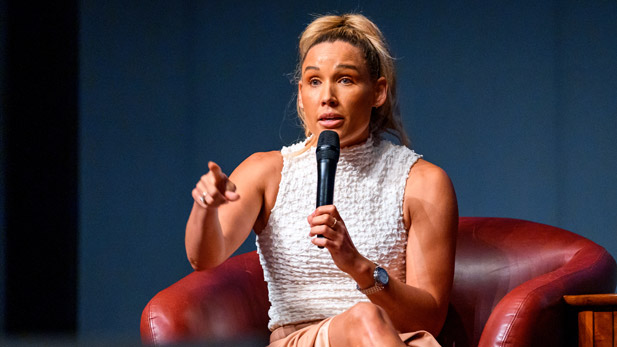
Three-time Olympian Lolo Jones advised students on overcoming hurdles, both literal and metaphorical during a Swearingen Leadership Series event on April 2.
Three-time U.S. Olympian Lolo Jones had students, faculty, and staff racing to Hatfield Hall for a fireside chat as part of the Swearingen Leadership Series on April 2. Jones, a four-time World Champion, is one of just 10 U.S. athletes to represent the nation at both the Summer and Winter Olympics, competing in track and field in 2008 and 2012 and in bobsled in 2014. Rose-Hulman Director of the Union and Student Activities Office and Title IX Coordinator Kristen Loyd moderated the conversation, prompting Jones with questions to inspire the audience.
Jones, the "gold-medal favorite" ahead of the women's 100-meter hurdles event at the 2008 Beijing Olympics, led the race finals and was on track to set a world record, until her foot clipped the ninth of 10 hurdles and caused her to finish in seventh place. Though utterly devastated, the experience shaped Jones' growth, and she shared powerful lessons of grace and resilience with the audience.
"We have to learn to embrace the hard things to have victories that are not just common, but life-changing," Jones said. "When I started to press into pain and embrace it, it built up a mental fortitude I could use. It's learning how to build up your inner muscles so nothing is going to break you."
Jones has trained her resilience muscles since childhood. Her family came from humble beginnings, which included experiencing homelessness and living in the basement of the Salvation Army. As she grew up and fell in love with track, Jones embraced a mindset of working harder than the person next to her. She shared that she taught herself to love the momentary misery of an intense workout in pursuit of her greater goal.
"The things that are hard that people just want to 'get through'…become really good at," she advised. "This is where I come alive."
After the 2008 Olympics, she continued to train her resilience with an Olympic-caliber regimen. In the year leading up to the 2012 London Olympics, Jones underwent spinal surgery to correct a rare genetic condition. With only a few months to train before the Olympics, Jones had to relearn how to walk and turned to intense visualization strategies to keep on pace for her goals. She defied the odds to earn a remarkable fourth-place finish in London.
Jones noted to the Rose-Hulman audience that, while she was proud of her finish, the world only saw her "failure" to medal, and she grew disillusioned with the sport and its pressure. Rather than give up her Olympic dreams, Jones used the disappointment to push her over the metaphorical hurdle and pivoted to a new goal: making the Olympic bobsled team.
"People always promote the medals…but these hiccups are life-changing for your character," Jones said. "Sometimes your 'failures' are the biggest fuel you'll get in your life. Failures can be the most motivational thing in your toolbox."
She encouraged the audience to keep a consistent routine in dogged pursuit of their goals, even when their lane seems filled with nothing but hurdles.
"Sometimes dreams need time. Sometimes a 'no' now is not a 'no' permanently," Jones explained.
After the talk, Jones joined members of the Student Athlete Advisory Committee for a free-flowing dinner discussion, during which students asked thoughtful, enthusiastic questions about topics from track tips to life in the Olympic Village and everything in between.
Also in attendance at the talk and the dinner was 1981 chemical engineering alumnus John Swearingen, who, along with his wife, Anne, created the Swearingen Leadership Series to enhance learning opportunities for students outside of the classroom.
Swearingen watched with pride as the students' questions caused the Olympic racer to pause to ponder.
"One of [her points] I really liked was 'learn from your failures,' because people will do a lot more failing than winning," said Swearingen. "I hope the people here sponge it up, take it to heart. It's just another learning opportunity that hopefully they can take with them."
The Swearingen Leadership Series welcomes several speakers from a variety of fields to campus each academic year to encourage development of leaders in science, engineering, and mathematics to solve complex problems. Previous speakers have included science communicator Hank Green, Microsoft executive Kate Maxwell, and 3M executive Jayshree Seth.