Rose-Hulman Assessment Director Publishes Paper on Evolution in Animal Mate Choice

Mitchel Daniel, Rose-Hulman’s Assessment Director, recently published an opinion piece on the evolution of animal mate choice in a special issue of the top-tier biology journal Philosophical Transactions of the Royal Society B.
For decades, biologists have been examining different species to attempt to determine why so much genetically-based variation exists. From fungi to flowers and fruit flies to humans, many species exhibit enormous variation in their traits. Yet, according to classic evolutionary theory, natural selection should eliminate most of this variation as the most “fit” individuals in each species prevail. Over the years, scientists have been trying to explain why there is so much variation within species, including Mitchel Daniel, Rose-Hulman’s Assessment Director. Daniel recently published an opinion piece in a special issue of the top-tier biology journal Philosophical Transactions of the Royal Society B to draw attention to an understudied theory of that might explain this variation.
In his article, “Origins and significance of preference for rare/novel male morphs: Trinidadian guppies as a case study,” Daniel reviews recent studies on the evolution of animal mate choice and argues that a preference for mates with rare or distinct traits may be widespread in animals, which could help to explain why many animal species have lots of variation in their traits. Daniel earned his doctorate in evolutionary biology at the University of Toronto and completed his postdoc at Florida State University where he began working on this research.
Daniel believes a potential explanation lies in the mating habits of Trinidadian guppies.
“If females prefer to mate with males that have rare or distinctive traits — a male that’s different from the rest — then there should be an evolutionary advantage to having rare traits because they will have an easier time finding mates and reproducing,” says Daniel. “That means males who are average will have a harder time courting females.”
Daniel goes on to note that if a trait is rare in the population, it should have an advantage and it should then become more common over time.
“If you think about that process playing out over evolutionary time, the advantage of rarity should prevent traits from being lost in the population. You’d expect genetic variation to build up in the population, and that may explain why we’re seeing more variation than what the classic models predict.”
Daniel notes the challenge with this research is designing an experiment to test these ideas.
“Part of what I wrote about is discussing the challenges involved in testing whether females have a mating preference for male traits,” says Daniel. “There are many different variables that go into choosing mates. Female guppies prefer males they haven’t encountered before, as well as males with specific traits like larger orange spots.”
To make progress, researchers have adjusted their experiments over time to control more variables and isolate the impact of rarity.
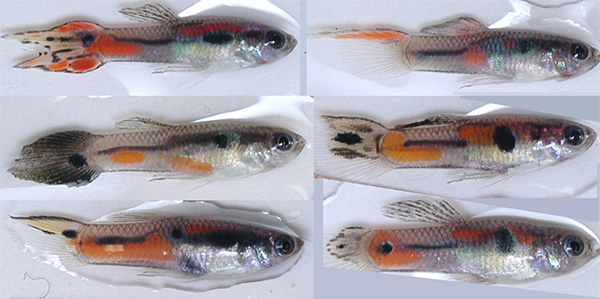 |
| Female Trinidadian guppies prefer males with rare or distinctive color patterns. The six males pictured here are all from the same natural population and every male has a noticeably distinct pattern. Image provided by Kimberly Hughes. |
The idea that females prefer males with rare or distinctive traits now has clear evidence behind it with guppies, Daniel argues. Yet, this idea has only been tested in a small number of other species, such as fruit flies and humans. He is eager to see if this could be a prevalent explanation for trait variation in many different species. Or whether it is limited to a few species; and if that’s the case, why?
He also poses a related question to this research: If females do have a preference for males with rare traits, why does that preference exist in the first place? One possibility is to avoid inbreeding. That is, if a male has a novel trait, he could be an immigrant from a different population with different traits. That would make female guppies less likely to mate with close relatives.
Daniel also theorizes that females may have evolved to be interested in novel things in general. This would make them more apt to explore their environment or try new food sources. “Maybe this preference for rare or novel color patterns could be an evolutionary byproduct of a general preference for novelty,” he says.
“There is still a lot that we don’t know about how important novelty is to female mating decisions, and why.” He hopes his paper will stimulate research to answer those questions.