Rose-Hulman Launches New Quantum Science, Computing & Engineering (QSCE) Certification
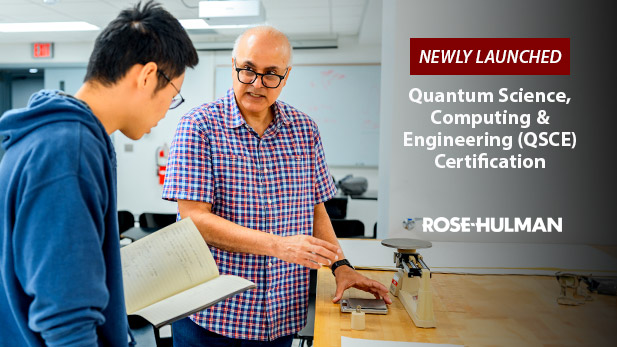
Rose-Hulman has launched a new Quantum Science, Computing & Engineering (QSCE) certificate that can help students define the future computation and information processing as part of the next information revolution.
Rose-Hulman has launched a new Quantum Science, Computing & Engineering (QSCE) certificate that allows students from STEM disciplines to become better acquainted with the fundamentals of QSCE and its potential to usher in the next information revolution. In an era that is often described as a “transistor moment,” the QSCE certification can help students be part of an up-and-coming enterprise that may define how computation and information processing looks for decades to come.
Quantum mechanics has the capability to transform the enterprise of information processing and computation. But the science — and equally important, the engineering — that is needed to realize the potential is just now catching up. This brings up the need for quantum-proficient scientists and engineers.
“Many students within the Department of Physics, Optical Engineering, and NanoEngineering are interested in topics related to quantum information, science, computing, and engineering,” said Maarij Syed, PhD, professor of Physics, Optical Engineering, and NanoEngineering. “These are individuals who do not have to be steeped into quantum mechanics research but need to understand the basic ideas at work. The certification will help them become better acquainted with those emerging areas and be part of that future workforce.”
The QSCE certification will officially be offered to students beginning in fall 2026. The certificate consists of three required core courses: Foundations of Modern Physics, Quantum Computing & Engineering, and Fundamentals of QISE. Students also take an additional two electives from an evolving list of science and engineering courses for a total of 20 credit hours. The guiding idea behind the curriculum is to make it attainable for students of diverse backgrounds to join the certificate program.
While offering a QSCE certification is not necessarily unique, Rose is offering the certification at the undergraduate level and in a focused way so many engineering disciplines can benefit. Whereas other institutions’ certification programs tend to be more physics-heavy and focused on graduate programs.
“We want this to be campus wide and so we’ve tried to assure access to the certificate is a level playing field,” Syed said. “We are focused on the fact that the quantum workforce needs to be very diverse. It needs to consist of technicians, electrical engineers, mechanical engineers, design engineers, process engineers … that's our vision behind this. We want to assure those engineers are comfortable with quantum concepts.”
One of the benefits for Rose students graduating with the QSCE certification is it will make them more employable and prepared for graduate study, as there is a growing need across the board for individuals with these skills. That is what PJ Daeger, a senior majoring in physics and mathematics, hopes to achieve with the certification.
During his first year at Rose, Daeger took Introduction to Quantum Computing with Syed, where he became interested in research opportunities within the field. The following summer, he completed a research project working with faculty to learn how to operate two quantum computers for Rose-Hulman. He enjoyed the work so much he spent his next two years continually learning and working on the computers.
Daeger will receive the QSCE certificate when he graduates next spring and plans to attend graduate school and earn a PhD, possibly in quantum computing.