Rose-Hulman Students Create Device to Continuously Monitor NICU Patients, Ease Nursing Workload
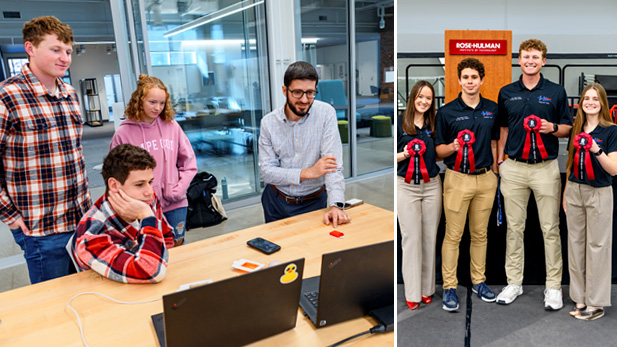
A group of Rose-Hulman biology and biomedical engineering majors developed PneumaNode, a device capable for continuously monitoring the vital signs of babies in the NICU, as part of their senior design capstone project.
Patients admitted to an intensive care unit (ICU) require continual monitoring, including regular checks of blood pressure, heart rate, respiratory rate, and lung function. These frequent assessments can interrupt sleep, cause discomfort, and require nurses to spend much of their shifts performing routine monitoring tasks. It was this problem that Rose-Hulman biology and biomedical engineering majors Tommaso Calviello, Alyssa McGauley, Connor O’Connell, and Katie Choi (Team TACK) solved as their senior design capstone project.
The problem was brought to Rose-Hulman by ResperCare LLC, an Indiana-based medical device startup, after a group of ICU nurses from IU Health approached them for help. The goal was to create a device capable of continuously monitoring patients with the same level of accuracy as bedside nurses. ResperCare LLC asked Rose-Hulman to design a solution and focus on babies in the neonatal intensive care unit (NICU).
The result was PneumaNode, a small, stick-on sensor patch that continuously monitors a baby’s vital signs so doctors and nurses can keep track of their health without needing to perform as many manual checks. The device will reduce clinician workload and improve diagnostic consistency.
PneumaNode uses a tiny MEMS microphone that listens to breathing and respiratory sounds, while a light-based PPG sensor measures heart rate and blood oxygen levels. A small ESP32-S3 computer inside the patch collects and processes the data. These feed into a custom PCB electrical surface in which the sensors, wires, microcontroller, and battery connect. All the vital sign components (heart rate, SpO2, temperature, and respiratory sounds) is aggregated in the ESP32 microcontroller before being transmitted via low Bluetooth energy wirelessly for real-time analysis.
Adel Alhalawani, PhD, assistant professor of biology and biomedical engineering, served as one of the team’s faculty advisors. He believes the PneumaNode team represents the very best of Rose-Hulman by combining technical excellence with professionalism and an unwavering commitment to improving patient care.
“What impressed me most was not only the quality of the solution they developed with ResperCare LLC, but the way they worked together as a team, listening to one another, embracing feedback, and consistently putting the success of the project ahead of individual recognition,” Alhalawani said.
O’Connell, a biomedical engineering major with a minor in data science, was excited to work on a project in which the students were responsible for the design process, and entered their senior year with a signed provisional patent application. The experience also gave Team TACK exposure to the intellectual property and legal aspects of biomedical product development. O'Connell said the collaborative nature of the senior design experience was one of the project's most valuable aspects.
“There are pain points and pressure with every capstone project, so being able to lean on each other, different resources and professors was really valuable,” he said. “Tommaso [Calviello] and I talked to electrical and computer engineering professors because some of that work was out of our scope. Within the BBE department, the professors always encouraged us to talk with them and ask questions. … I’ve always embraced the ability to ask questions, but having the courage to seek help really rang true in delivering on a professional project.”
TeamTACK presented the PneumaNode capstone project at the annual Rose Show on May 6 where they won a Red Ribbon Department Award. Nearly 130 students presented capstone, design, studio, and research projects at the Rose Show, showcasing the innovative work that culminates a Rose-Hulman education.