Summer Innovations at Rose-Hulman Ventures
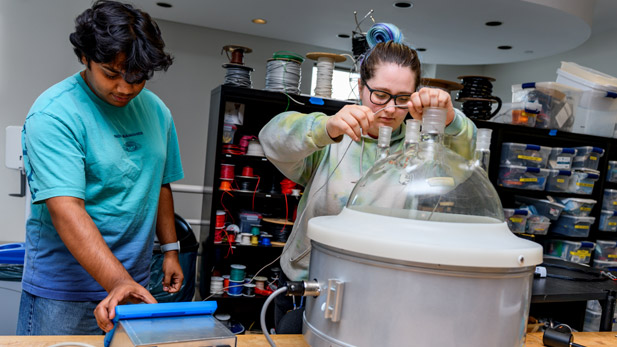
At Rose-Hulman Ventures, client companies seek products, software, and solutions from Rose-Hulman students, who gain industry experience among a project team of peers.
What happens when Rose-Hulman students step into an innovation lab and work alongside experienced engineers and designers? At Rose-Hulman Ventures, they become part of a project team developing new products, software, and solutions for clients. These stories highlight the students who spent their summer learning, creating, and contributing to that work.
minh Nguyen
Some ideas stay on paper. Others become products used by real people. For junior mechanical engineering major Minh Nguyen, this summer was all about taking ideas off the page and putting them to the test through his internship with Rose-Hulman Ventures.
Nguyen worked on projects ranging from sports equipment to medical devices, helping develop and test prototypes along the way. One project involved creating an affordable syringe gun for StemSys, designed to help users dispense healing gel accurately and consistently.
Nguyen learned quickly that even small design choices can have unexpected consequences. While working on a 3D printed prototype, he chose an orientation that would give the finished part a smoother surface but also left him with a lot of support material to remove.
“I thought that as long as I turned on the ‘support material’ option, I didn’t need to worry about anything,” Nguyen said.
“It took me 30 minutes to use pliers with jaws as long as my fingers to remove them.”
That small headache became a bigger lesson: a part is not finished just because it looks good on the screen. Nguyen also learned that lesson after spending two weeks developing a prototype that was ultimately rejected by a client.
“It’s definitely discouraging in the moment,” Nguyen shared. “However, the experience forced me to look back into my Intro to Design training, and that’s where I learned my lesson.”
Nguyen entered the internship thinking he was more of an “improver” than a creator and was not sure product development was for him. After getting the chance to develop a product himself, he found that he enjoyed the process. For Nguyen, the summer gave him a chance to test an idea of his own — what kind of engineer he wants to become — and he may have found an answer. Sometimes an internship does not just teach you what you want to do; it reveals something you never knew you were capable of doing.
Basil Grimes
Senior software engineering major Basil Grimes spent the summer tackling complex software challenges through Rose-Hulman Ventures. Working on a large C ++ application for an industry client, they helped modernize an existing software platform while preserving the functionality that users have relied on for years.
Their work centered on refactoring a codebase that initially would not compile, improving everything from the user interface and data processing to error handling and software compatibility. Each day brought a different challenge, whether it meant restoring old functionality, digging through legacy code to understand previous implementations, or researching new approaches using the Qt and Qwt libraries. One project even gave them the opportunity to switch from C ++ to Python to create a tool for converting legacy files into a new format.
“The variety of what people are working on is always interesting to hear about,” Grimes said. “Whenever I need a change of perspective, I can check out what others are working on, which is usually very different than what I’ve been doing.”
Working on an established codebase gave Grimes valuable insight into the realities of professional software development. Along the way, they strengthened their understanding of Git version control, software design patterns, and how to build solutions that future developers can continue to improve rather than replace.
For Grimes, the experience reinforced that real-world software engineering is rarely about starting from scratch. Instead, it is about understanding complex systems, collaborating with clients and teammates, and finding thoughtful ways to improve software that people rely on every day.
Rachel Greenlee
You do not always discover what you like by sticking with what you already know. Rachel Greenlee learned that firsthand this summer.
The Terre Haute sophomore computer science major worked as a lab technician, helping wherever the Electrical Engineering team needed her. She kept track of the lab’s inventory, helped assemble demonstration components, and researched ideas that came through Ventures before a project moved forward. When a concept comes through Ventures, that research can help determine what comes next. Greenlee looks into existing products, compares how they work, and explores different approaches when a team is deciding how to bring an idea to life. Her work gives the team the information it needs before committing time and resources to a design.
“I have become much more confident in my ability to teach myself skills from scratch,” she said.
With help from supervisors and fellow students, along with plenty of independent research, Greenlee has learned to identify electrical components and sharpen her soldering skills. More importantly, she has become willing to try something before she knows exactly how to do it.
“I’ve discovered that I enjoy working with wiring and tinkering with different components that I previously had no interest in,” Greenlee said.
Greenlee has gained a better idea of what makes her curious. For a computer science student who once felt nervous about working with anything beyond a screen, discovering a new side of engineering might be one of the most valuable projects of the summer.
Jacob Tuck
As a mechanical engineering and engineering design major pursuing a concurrent master’s in engineering management through Rose-Hulman's Rose Squared program, Jacob Tuck has spent his time at Rose-Hulman Ventures gaining hands-on product development experience that mirrors the career he hopes to pursue after graduation. Originally from Plainfield, Illinois, the Rose-Hulman senior has worked on multiple client projects, designing, building, and refining products while collaborating directly with industry partners.
No two days at Rose-Hulman Ventures looked the same. Depending on the project, Tuck could be creating CAD models, manufacturing parts in the shop, or meeting with clients to present progress and gather feedback. One of his most challenging assignments involved redesigning an existing product to improve its appearance while preserving its functionality, pushing him to think beyond engineering performance and consider aesthetics as part of the design.
One of the biggest differences Tuck found at Ventures was the level of ownership that students receive.
“One of the things I love about Ventures is that I am not some faceless intern working in the background of a project,” Tuck explained. “The other interns and I have almost full creative freedom when ideating and testing prototypes, and when it comes time to present our work to the clients, it is us running the meetings and directly receiving feedback on our designs.”
The experience also reinforced how much of his Rose-Hulman education applied outside of the classroom. Tuck found himself applying lessons from courses in mechatronics, measurements, and design for manufacturing as he built prototypes, wired electronics, calibrated sensors, and developed mathematical models.
As he prepares to begin his career in product development, Tuck says the opportunity to work with real clients and solve real engineering challenges has given him valuable experience and stories he can confidently share with future employees.
Esly Cerritos
Every click, screen, and app is a conversation, and it starts as someone’s idea. Born in El Salvador and raised in Indianapolis, senior computer science student Esly Cerritos learned that building software is not just about knowing how to code. Cerritos worked with clients to shape ideas into web and mobile applications while gaining firsthand experience in professional software engineering.
From creating mockups and developing software to presenting progress updates and gathering client feedback, Cerritos learned about listening closely to the people who will use what she creates. Weekly meetings challenged the team to refine ideas, solve problems, and build applications that met each client’s needs.
One of her most challenging projects involved revisiting a client-facing mockup multiple times before reaching a final design. Each round gave her a better understanding of what the client was looking for and how small changes can make an application more useful.
“It taught me a lot about how to take a client's feedback and translate it into design changes,” Cerritos said.
Working directly with clients gave her a new appreciation for the role communications plays in software engineering. Alongside building applications, Cerritos strengthened her skills in gathering requirements, collaborating with a development team, and adapting to changing project needs. Experience with GitHub, ASP.NET, and modern development frameworks also helped bridge the gap between classroom learning and professional software development.
Every project reminded Cerritos that software development is about more than writing code. At the end of the summer, she walked away with more than completed projects. The experience strengthened technical skills, built confidence working with clients, and showed that the best software comes from listening, collaborating, and continuously improving.
Kellen Groesbeck
Junior mechanical engineering student Kellen Groesbeck, from Scottsdale, Arizona, spent his summer at Rose-Hulman Ventures helping launch one of the organization’s newest manufacturing capabilities. Working with an industrial injection molding machine, he took the lead in setting up, turning, and helping train fellow interns on how to use it.
Each day combined hands-on manufacturing with engineering design. From creating molds and experimenting with the machine to collaborating with teammates on their own projects, Groesbeck gained experience solving problems in a fast-paced environment where every project presented a new challenge.
One lesson that stood out throughout the summer was that engineering is rarely a solo effort.
“While it’s a very project-based team, work has been something that I have been able to improve as I don’t have to do everything myself,” Groesbeck shared. “Working with EEs (electrical engineers) has been fun.”
Groesbeck also appreciated the level of ownership Ventures gives its interns. Rather than supporting projects from the sidelines, he was trusted to make decisions, improve manufacturing processes, and take responsibility for a major piece of equipment. He credits Rose-Hulman’s fast-paced curriculum for preparing him to step into that role with confidence.
Looking ahead, Groesbeck hopes to build a career in the aerospace industry, ideally working on rockets. He believes the combination of hands-on manufacturing experience, cross-disciplinary teamwork, and project ownership he gained at Ventures has provided a strong foundation for that goal.
Reflecting on his experience, he hopes more students recognize the opportunities available through Rose-Hulman Ventures, noting that the experience provides meaningful, industry-relevant work that prepares interns for successful engineering careers.
Logan Wenzel
A bad cut can ruin a part, and a wrong tool can ruin a day. For junior mechanical engineering student Logan Wenzel, learning how to recognize a problem and rethink the process became one of the most valuable lessons of his summer at Rose-Hulman Ventures.
Wenzel worked alongside the mechanical technician in the Ventures machine shop, helping support projects across campus. His work included designing fixtures in SolidWorks, preparing parts for machining, and using CNC and manual machines to turn designs into functional components. He also worked with 3D printing and Prusa Slicer for smaller-scale prototypes.
There was one project in particular that put his growing machining skills to the test. While working with 4140 steel, Wenzel encountered poor surface finishes and repeated tool breakage while preparing the material. Instead of continuing with the same approach, he and the mechanical technician stepped back, changed the cutting inserts, and increased the depth of each cut. The adjustment produced a much better finish and allowed the work to continue.
Wenzel said, "The biggest lesson that he taught me is that sometimes taking a step back and looking at your problem from another point of view and thinking about it could be the answer to your problem.”
Much of Wenzel’s summer was spent making fixtures and stands that helped other projects move forward. Some were built to hold components during heat-resistance testing, while others helped teams fasten or position parts before adding wiring and other components. Although the projects themselves were often behind the scenes, the fixtures helped make testing and assembly possible.
Working with different engineering disciplines also changed how Wenzel thinks about his own designs. He learned that a decision made during fabrication can affect how another team eventually assembles or uses a part.
Wenzel hopes to become the kind of engineer who can design and machine a prototype himself, but his experience at Ventures has given that goal a broader meaning. He wants to be an engineer who listens, considers different perspectives, and is willing to rethink his first answer.
“I want to be the engineer who is able to look at things from multiple points of view and take people’s advice because I will never know everything,” Wenzel explained.
Luke Pearcy
After graduating in the spring of 2026 from Rose-Hulman with a degree in computer science, Luke Pearcy continued building professional software solutions as a student intern with Rose-Hulman Ventures. During his year and a half with Ventures, he has worked on eRAMx, a web and mobile application that facilitates remote drug testing through secure two-way video communication between participants and trained observers.
Pearcy joined the project during a major grant-funded effort to migrate the application from .NET Framework to .NET Core, helping rewrite the software using modern technologies. Since completing the migration, he has continued to develop new features that expand the platform’s capabilities for clients.
A typical day begins with project meetings alongside teammates and a project manager to discuss priorities before diving into development work. Weekly client meetings provide opportunities to review progress, gather feedback, and plan upcoming work.
Pearcy explained, “What’s really cool about Ventures is that the whole project team works in the same building as you. If you ever have questions about anything on the project, my whole team is usually working right next to me.”
One of Pearcy's favorite aspects of working at Rose-Hulman Ventures has been the opportunity to continue his internship throughout the academic year.
“Many internships are restricted to summer only, but I kept working at Ventures for 10 hours each week during the school year,” he said. “The project managers are flexible with your work schedule since most of them are Rose alumni who know what it’s like to be a Rose student.”
Working on production software for a long-standing client, eRAMx gave Pearcy experience that extended well beyond the classroom. From maintaining decades-old software systems to gathering requirements directly from clients, he developed technical and professional skills while seeing firsthand how the team’s work supports a real business.
Pearcy said his Rose-Hulman education prepared him to quickly learn new technologies by giving him a strong foundation in problem-solving and adaptability. As he begins his professional career, he believes the year and a half of continuous, real-world software development experience gained through Rose-Hulman Ventures has given him a significant advantage in the job market.