Vampires and Variables: Author Michelle McGill-Vargas Sparks Creativity in STEM
Thursday, April 02, 2026
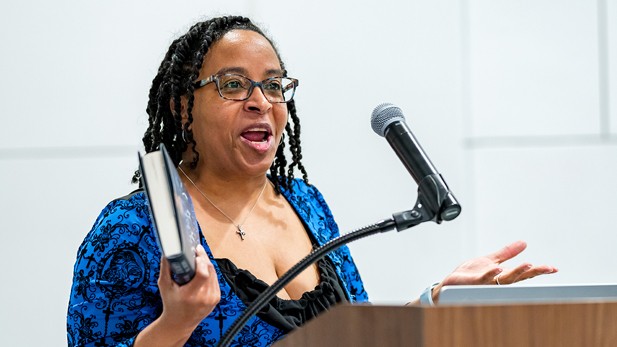
Michelle McGill-Vargas, author of "American Ghoul", encouraged students to pursue their creativity during spring convocation, drawing connections between STEM and speculative fiction.
Indiana author Michelle McGill-Vargas inspired students to infuse creativity into every aspect of their lives during Rose-Hulman's Spring Convocation on March 19, offering insights into which they could sink their teeth and suck out all the marrow of life. A historical horror author, McGill-Vargas launched the discussion by reading a few pages from her debut novel, "American Ghoul", which follows the journey of a newly-freed slave who finds herself caring for a vampire.
McGill-Vargas' book falls under the umbrella of speculative fiction — a genre that includes subsects like fantasy, science fiction, alternative history, and dystopian works. Stories in this genre reimagine the world in a way altered from reality, either inserting mystical, magical, or futuristic elements into the world the audience knows, or by building a new world entirely.
Though vampires and ghouls seem like a large leap from the voltages and gears with which Rose-Hulman students are familiar, McGill-Vargas observed that her craft in many ways mirrors the craft of the STEM scholars before her.
"They both start with 'What if?'" she explained. "Some of the speculative novels and fiction from a long time ago are the STEM you do now."
To demonstrate, McGill-Vargas asked the crowd for the "What ifs" currently being explored in their fields. One student speculated about a computer that could solve any problem; another wondered about the impact of reverse osmosis membranes for universal water purification.
From the podium, McGill-Vargas smiled. "What we do changes the world or someone's view of it," she emphasized.
In both speculative fiction and STEM education, the mindset leading to that impact follows a similar path, and McGill-Vargas drew connections between the writing process and the scientific method.
"It all sparks from that idea," she noted. Writers and researchers then "do the math" — determining the pacing of their story or the formulaic foundation of their project — before plotting and planning their methods. Before the "what if" becomes a "why not", authors of both fiction and fact must earn acceptance from their community.
"When you're trying to sell an idea, it has to be something the public can take in," McGill-Vargas said.
Throughout the discussion, audience members thoughtfully contributed their ideas, including Sayura Lokhande, a student in the front row who impressed McGill-Vargas with the breadth and depth of her interests. Lokhande is a sophomore majoring in computer science, mathematics, and computational science, who shared during the presentation that she hopes to become a more active writer.
"It feels like I have more motivation to go ahead and do it. It's the sense of community and also having other people around that I can talk to about it," said Lokhande after the talk.
McGill-Vargas advised Lokhande and other students to embrace their passions now, including those outside of their STEM studies, rather than waiting for the perfect time.
"What are some things you could do to enhance that passion you love?" she prompted. "Know it will take a while. But just try it. It's always going to be something of yours that you can always share with people."
McGill-Vargas, an Indiana native and special education teacher, writes speculative historical fiction, short stories, and flash fiction. Her work has appeared in Splickety Magazine, the Copperfield Review, and Typehouse. She has served as vice president of the Indiana Writers' Consortium and on the board of Midwest Writers Workshop and the Historical Novel Society. She currently resides in the Midwest with her husband and fur babies.
McGill-Vargas' book falls under the umbrella of speculative fiction — a genre that includes subsects like fantasy, science fiction, alternative history, and dystopian works. Stories in this genre reimagine the world in a way altered from reality, either inserting mystical, magical, or futuristic elements into the world the audience knows, or by building a new world entirely.
Though vampires and ghouls seem like a large leap from the voltages and gears with which Rose-Hulman students are familiar, McGill-Vargas observed that her craft in many ways mirrors the craft of the STEM scholars before her.
"They both start with 'What if?'" she explained. "Some of the speculative novels and fiction from a long time ago are the STEM you do now."
To demonstrate, McGill-Vargas asked the crowd for the "What ifs" currently being explored in their fields. One student speculated about a computer that could solve any problem; another wondered about the impact of reverse osmosis membranes for universal water purification.
From the podium, McGill-Vargas smiled. "What we do changes the world or someone's view of it," she emphasized.
In both speculative fiction and STEM education, the mindset leading to that impact follows a similar path, and McGill-Vargas drew connections between the writing process and the scientific method.
"It all sparks from that idea," she noted. Writers and researchers then "do the math" — determining the pacing of their story or the formulaic foundation of their project — before plotting and planning their methods. Before the "what if" becomes a "why not", authors of both fiction and fact must earn acceptance from their community.
"When you're trying to sell an idea, it has to be something the public can take in," McGill-Vargas said.
Throughout the discussion, audience members thoughtfully contributed their ideas, including Sayura Lokhande, a student in the front row who impressed McGill-Vargas with the breadth and depth of her interests. Lokhande is a sophomore majoring in computer science, mathematics, and computational science, who shared during the presentation that she hopes to become a more active writer.
"It feels like I have more motivation to go ahead and do it. It's the sense of community and also having other people around that I can talk to about it," said Lokhande after the talk.
McGill-Vargas advised Lokhande and other students to embrace their passions now, including those outside of their STEM studies, rather than waiting for the perfect time.
"What are some things you could do to enhance that passion you love?" she prompted. "Know it will take a while. But just try it. It's always going to be something of yours that you can always share with people."
McGill-Vargas, an Indiana native and special education teacher, writes speculative historical fiction, short stories, and flash fiction. Her work has appeared in Splickety Magazine, the Copperfield Review, and Typehouse. She has served as vice president of the Indiana Writers' Consortium and on the board of Midwest Writers Workshop and the Historical Novel Society. She currently resides in the Midwest with her husband and fur babies.