Rose-Hulman Alumnus Jeremiah Tate Chips in to Create Microsoft CPU
Wednesday, October 14, 2026
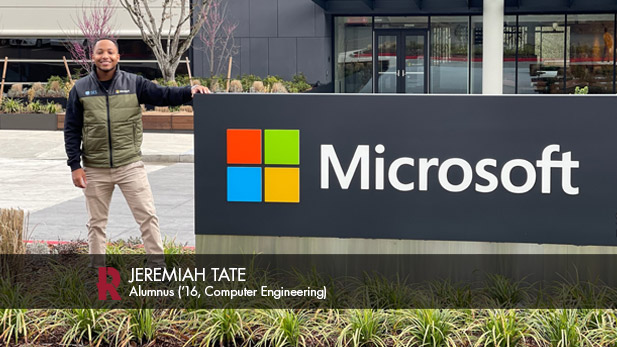
Jeremiah Tate, a 2016 computer engineering alumnus, helped develop Microsoft Cobalt, the company's first general-purpose CPU, which today powers many Microsoft Teams videocalls.
Embedded in nearly every workplace and every home around the world is a small chip of Jeremiah Tate's knowledge. Tate, a senior hardware design verification engineer at Microsoft, helped create Microsoft's first-ever central processing unit (CPU) for common customer workloads. Tate was part of the engineering effort behind Microsoft Cobalt, the company’s first internally designed CPU for its cloud infrastructure. Cobalt powers countless Microsoft products, including many videocalls through Microsoft Teams.
"The fact that people can come together and create something that literally fits in your hand that just has so much impact on society is amazing to me," said Tate, a 2016 computer engineering graduate. "We actually work off the chips we built. We're building better versions of the chips using the older generation."
Though custom silicon is increasingly central to Microsoft’s cloud infrastructure today, the idea of Microsoft developing its own general-purpose CPU seemed radical when Tate joined the company six years ago.
"It felt like the craziest thing to me that I would be joining a team to build something from the ground up. It felt like we were at a startup," he said.
Now, as he shepherds Cobalt 200 — a newer, faster, generation of processor designed for the era of enterprise and agentic AI usage — Tate’s verification role has evolved to focus increasingly on power, performance, and system-level behavior.
"My job is to instill confidence in the design. I have to understand how it's created and then ways I can break it," he said. "How are the users going to interact with it? What are some things we don't want the user to have happen when they use our product? What are some things we want to absolutely have the user have the capability to do?"
Though his role is a highly technical one, Tate views himself as a creator who sculpts society through science.
"Engineers are artists with constraints," he said. "The best inventions often come from constraints. Engineers have to find a way to the solution within those constraints.”
Tate's artistic medium of choice was a computer engineering major at Rose-Hulman, something that he felt blended his favorite aspects of both the computer science and electrical engineering disciplines.
"I get the best of both worlds. I get to learn how the hardware is actually made and the code that runs on top of the hardware," he grinned, remembering a senior-level course on field programmable gate arrays. "That was when I felt like I had a superpower."
Tate, who previously worked at Intel, primed his palette of proficiencies while at Rose-Hulman, and he finds himself leaning on his learnings, even from courses that are less directly related to his current role, such as semiconductor fabrication in the MiNDS cleanroom lab.
"It gives you a better mental picture when you're solving problems in industry," he said. "A lot of those classes gave me the experience to create mental images with more clarity."
Tate also hopes to provide others with career clarity because, as much as he believes technical constraints create innovation, he hopes to remove the social constraints that limit innovative curiosity. Tate, the youngest of five, is the only one of his siblings to have graduated high school, starting Rose-Hulman at just sixteen years old. He vowed to extend a helping hand to others whenever possible and serves on the board of GEO Academies, a nonprofit organization which manages five charter school districts, including the school system Tate attended. Tate has also mentored several young professionals as they started their journey in the industry.
"A lot of kids from economically disadvantaged communities don't get a lot of opportunities for people to come out and pay it forward for them. While I had people come into my life, there was some luck involved with that," he said. "I want to eliminate that luck as much as possible."
He noted that, at Microsoft, much like Rose-Hulman, he works with a talented team of individuals and knows when to lean on their expertise, a lesson he hopes to impart to students and mentees.
"When you graduate from Rose-Hulman, you come out with a healthy amount of humility, and the best engineers I have worked with also have that same humility," he said. "You approach things more systematically."
He credits Rose-Hulman for teaching him to thrive in collaborative communities, surrounded by like-mindedly curious creators.
"Those skillsets have allowed me to gain success outside of Rose as well, and I still live by a lot of things that I learned over my experience," he said.
"The fact that people can come together and create something that literally fits in your hand that just has so much impact on society is amazing to me," said Tate, a 2016 computer engineering graduate. "We actually work off the chips we built. We're building better versions of the chips using the older generation."
Though custom silicon is increasingly central to Microsoft’s cloud infrastructure today, the idea of Microsoft developing its own general-purpose CPU seemed radical when Tate joined the company six years ago.
"It felt like the craziest thing to me that I would be joining a team to build something from the ground up. It felt like we were at a startup," he said.
Now, as he shepherds Cobalt 200 — a newer, faster, generation of processor designed for the era of enterprise and agentic AI usage — Tate’s verification role has evolved to focus increasingly on power, performance, and system-level behavior.
"My job is to instill confidence in the design. I have to understand how it's created and then ways I can break it," he said. "How are the users going to interact with it? What are some things we don't want the user to have happen when they use our product? What are some things we want to absolutely have the user have the capability to do?"
Though his role is a highly technical one, Tate views himself as a creator who sculpts society through science.
"Engineers are artists with constraints," he said. "The best inventions often come from constraints. Engineers have to find a way to the solution within those constraints.”
Tate's artistic medium of choice was a computer engineering major at Rose-Hulman, something that he felt blended his favorite aspects of both the computer science and electrical engineering disciplines.
"I get the best of both worlds. I get to learn how the hardware is actually made and the code that runs on top of the hardware," he grinned, remembering a senior-level course on field programmable gate arrays. "That was when I felt like I had a superpower."
Tate, who previously worked at Intel, primed his palette of proficiencies while at Rose-Hulman, and he finds himself leaning on his learnings, even from courses that are less directly related to his current role, such as semiconductor fabrication in the MiNDS cleanroom lab.
"It gives you a better mental picture when you're solving problems in industry," he said. "A lot of those classes gave me the experience to create mental images with more clarity."
Tate also hopes to provide others with career clarity because, as much as he believes technical constraints create innovation, he hopes to remove the social constraints that limit innovative curiosity. Tate, the youngest of five, is the only one of his siblings to have graduated high school, starting Rose-Hulman at just sixteen years old. He vowed to extend a helping hand to others whenever possible and serves on the board of GEO Academies, a nonprofit organization which manages five charter school districts, including the school system Tate attended. Tate has also mentored several young professionals as they started their journey in the industry.
"A lot of kids from economically disadvantaged communities don't get a lot of opportunities for people to come out and pay it forward for them. While I had people come into my life, there was some luck involved with that," he said. "I want to eliminate that luck as much as possible."
He noted that, at Microsoft, much like Rose-Hulman, he works with a talented team of individuals and knows when to lean on their expertise, a lesson he hopes to impart to students and mentees.
"When you graduate from Rose-Hulman, you come out with a healthy amount of humility, and the best engineers I have worked with also have that same humility," he said. "You approach things more systematically."
He credits Rose-Hulman for teaching him to thrive in collaborative communities, surrounded by like-mindedly curious creators.
"Those skillsets have allowed me to gain success outside of Rose as well, and I still live by a lot of things that I learned over my experience," he said.